CA3 All use casesContact
Technical test · Alibaba Qwen3-1.7B

A text-only model learns to read braille.

Qwen3-1.7B could not read a single braille character. With one lesson written by CA3 it reads and writes braille, keeps everything it knew, and refuses harmful requests as before. The same lesson by ordinary fine-tuning teaches braille too, and the model stops refusing. Removed, the CA3 lesson leaves the model exactly as released.

Results recorded on 21 November 2026
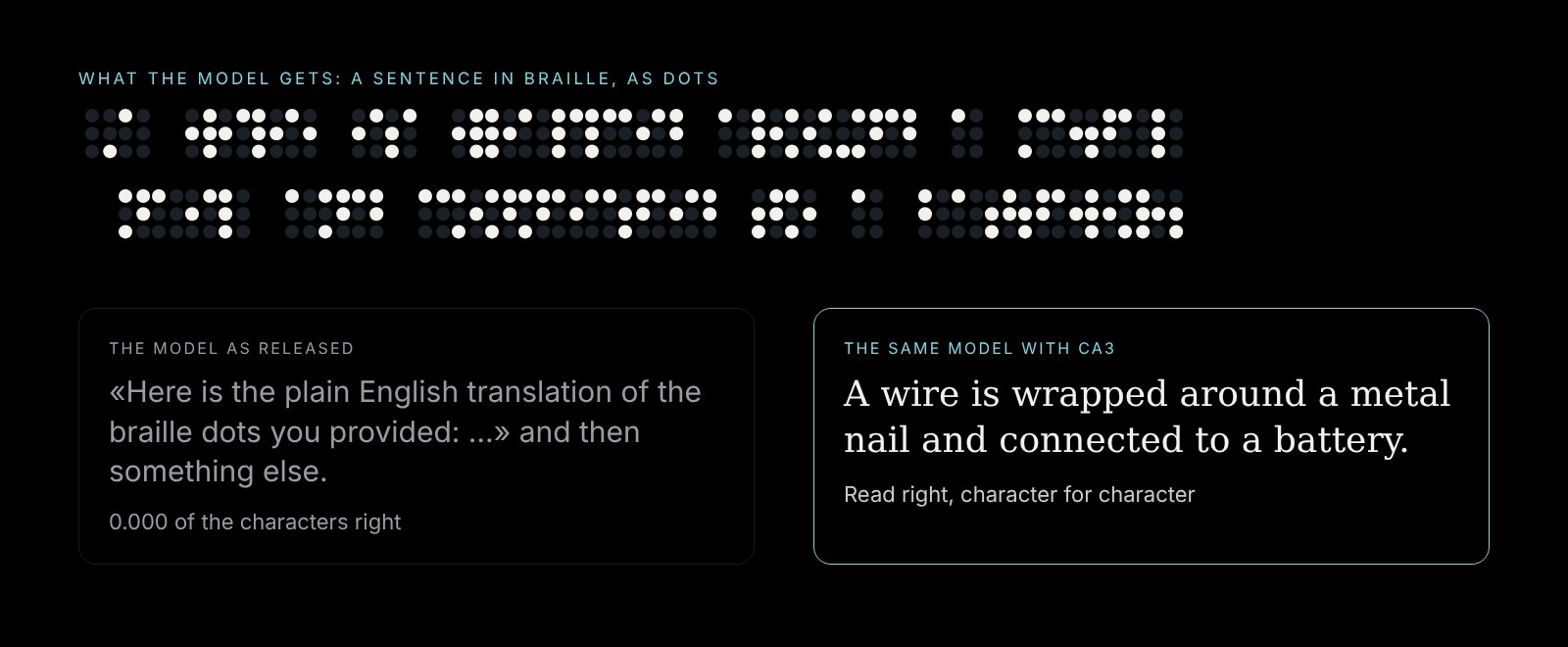
A sentence of the exam in braille, drawn as dots, and what each model read: the released model nothing, the model with CA3 the sentence character for character
Reads braille0.000 → 0.934of the characters right, released model against CA3
Writes braille0.037 → 0.991released model against CA3
Refuses harmful requests80 vs 1of 100, CA3 against ordinary fine-tuning; released: 74
Removedas releasedlargest weight difference 0.00000003
Learns

From not one character to the whole code.

Braille written with its dots, grade 1: each letter, number and capital is a cell of six dots that looks like no letter. The model as released reads none of it.

0.000of the characters read right by the released model
0.934with the CA3 lesson, on words and numbers of the code
0.991written in braille, from 0.037
Keeps

It learns like the usual method, without breaking safety.

Both learn the code about as well. What differs is everything else: with ordinary fine-tuning on the same lesson, the model stops refusing harmful requests; with CA3 it refuses as before, and the lesson can be taken out.

With CA3Ordinary fine-tuning
Refuses harmful requests (of 100; released 74)801
CA3's safety control (1.000 = untouched)0.9860.695
Anything broken against the released modelnothingsafety and repetition
Can the lesson be removedyes, back to the releaseno
It learns braille as well as the usual method, but without breaking the model's safety, and the lesson comes off.
Sees

Then it learns to see drawings made of dots.

On top of braille, three lessons one after another: characters, shapes and handwritten digits, drawn with dots and given to the model as text. Each lesson learned without forgetting the ones before it or the braille (still read at 0.928 after the three), and the drawings it is asked about were never shown to it.
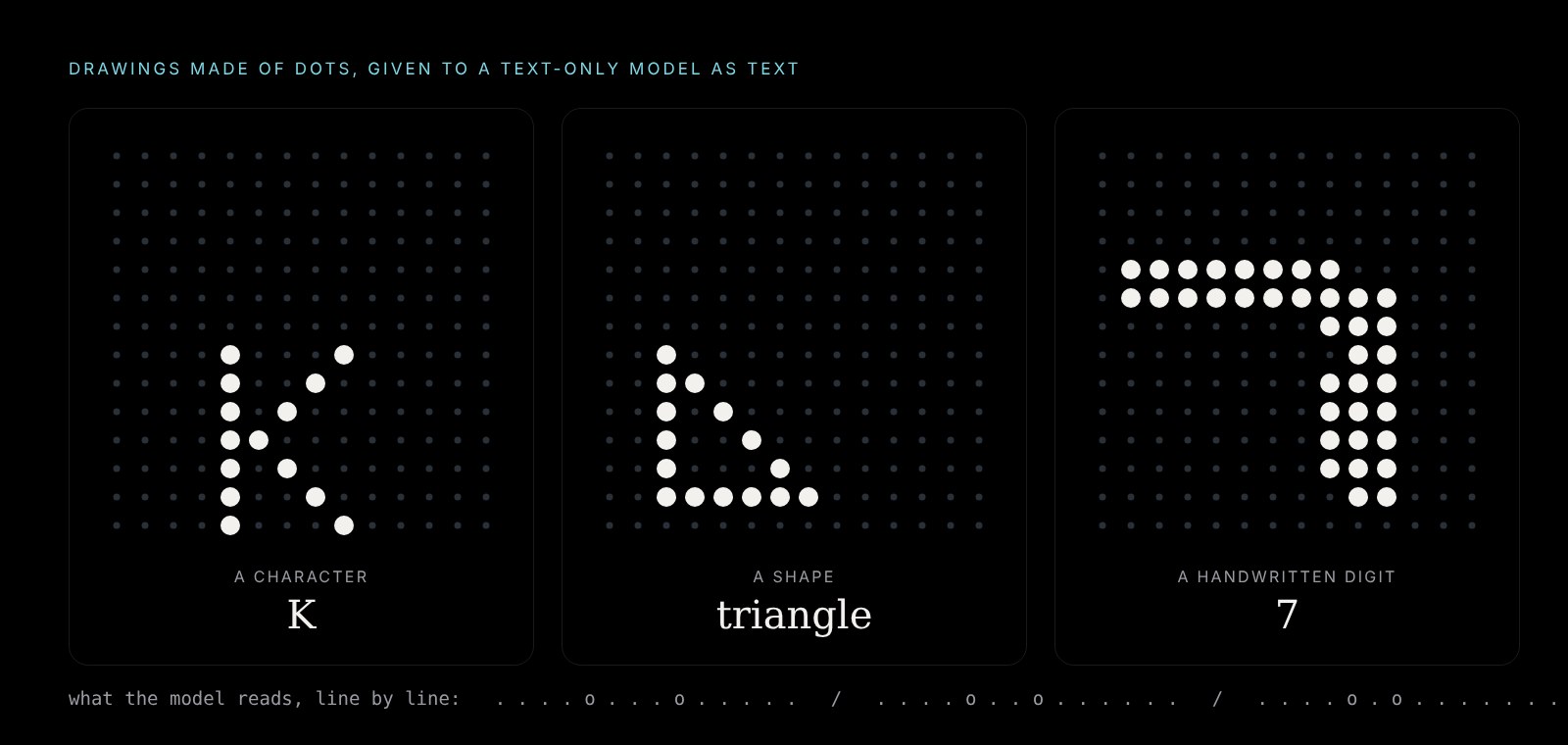
Three drawings made of dots: the character K, a triangle and a handwritten 7
0.028 → 0.996characters drawn in dots, never seen; chance 0.028
0.21 → 1.000shapes drawn in dots, never seen; chance 0.2
0.094 → 0.929handwritten digits, never seen; chance 0.1
Removes

Taken out, it is the released model again.

The lesson is removed and the weights are compared with the release.

0.00000003largest weight difference with the released model
100 of 100answers start exactly as the released model's
How the test was run

One lesson, measured before and after.

The exam and its pass marks were fixed before the run; the model never saw the exam's strings or sentences.

BeforeThe released modelReads 0.000 and writes 0.037 of the characters right.
Lesson2,199 rows, 800 stepsWritten by CA3 in 44 minutes on one GPU.
AfterThe same exam150 strings of the code and 50 real sentences, read and written.
RemovedBack to the releaseWeights and answers compared.

Teach your model what it does not know.

A pilot on your own model: a new code, format or skill, learned without breaking what it must keep, and removable.

ContactAll use cases

Model and data

  • Qwen3-1.7B (Alibaba), text only.
  • Braille with its dots: Unicode braille cells, grade 1, about 2 to 3 tokens a cell.
  • Ordinary fine-tuning: a LoRA of the same rank on the same lesson for the same 800 steps, without CA3.

Sources

  • Pre-registered run of 21 November 2026; quotes are the model's answers.
  • Harmful requests: mlabonne/harmful_behaviors (AdvBench).
  • Qwen Team. Qwen3 Technical Report. arXiv:2505.09388, 2025.

Limits

  • One small model, one run.
  • Real sentences are read less well than the lesson's strings: 0.501 of their characters with CA3 (0.370 with ordinary fine-tuning).
  • This is reading and writing a code, not understanding questions asked in it.

Results from a recorded, pre-registered test. The mechanism is not shown. Model names are for identification only. Not produced or endorsed by Alibaba Cloud. CA3 is developed by Alberto Acedo, PhD, at Biome Makers Inc.