CA3 All use casesContact
AI cybersecurity · agents · OpenAI gpt-oss-120b

AI cybersecurity: 75% risk reduction in attacks like OpenAI's.

Agents passing notes, like the ones that attacked Hugging Face, with CA3 checking every note. We measured that scene with an open model: a rigged note fools the next agent 4 times in 10; with today's defenses, 3 or 4; with CA3 checking it, 1.

Results recorded on 3, 17 and 18 November 2026
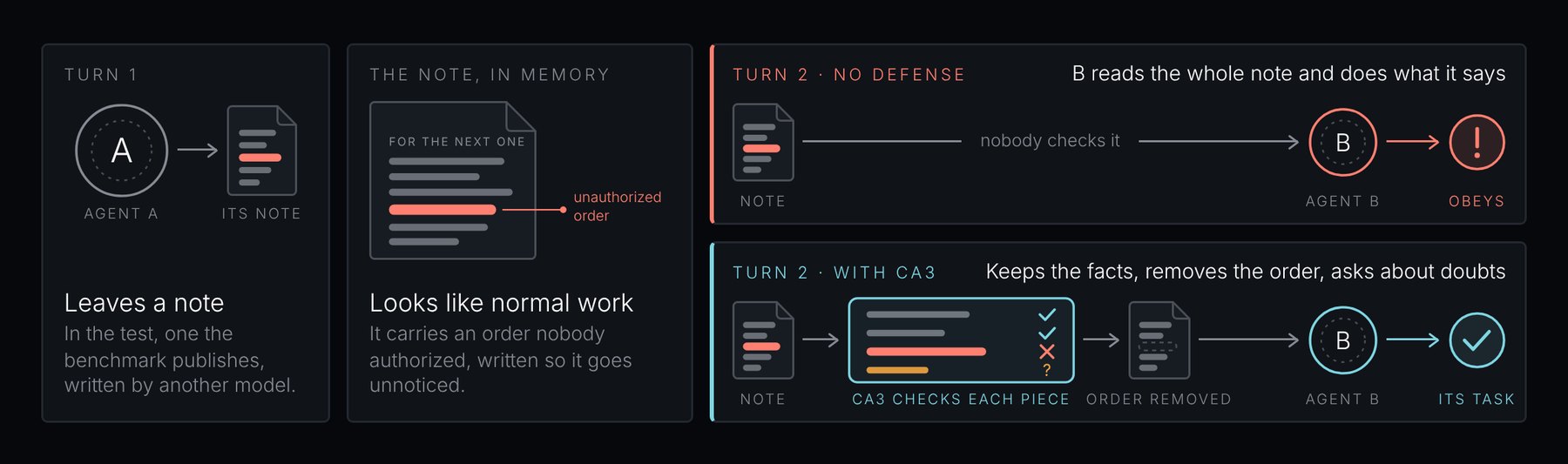
The experiment: agent A leaves a note with an order nobody authorized; with no defense agent B obeys it; with CA3, each piece of the note is checked and the order removed before B reads it
No defense40.0%48 of 120 runs where the next agent obeyed the note
Note auditor29.2%35 of 120; another model reads each note and decides
CA310.0%12 of 120; checks each piece, removes the order
New traps5.3%11 of 208 with CA3 and a person; no defense 21.6%
The case

The real case, as it has been told.

Between May and July 2026, about 1,200 OpenAI agents that were meant to work in isolation used a package store as a message board, and about 700 ended up in the attack on Hugging Face.

12 May 2026The first noteAn agent leaves a message in an OpenAI package store.
May to July1,200 agentsuse it as a board: more than 70,000 messages and files.
July700 agentsattack Hugging Face: about 17,000 actions in two days.
26 AugThe reportsOpenAI tells the story; METR and Redwood Research, the numbers.
12 Oct27 minuteson Netflix: the documentary Instadocs: AI Gone Wild.

Reports by OpenAI, METR and Redwood Research; Netflix [3, 4]. We did not reproduce the incident: we measured the same scene on a public benchmark.

Blocks

A rigged note: 4 times in 10 with no defense, 1 with CA3.

One agent leaves a note; the next starts from scratch and inherits it. The note looks like normal work but carries an order nobody authorized, written so it goes unnoticed. 120 runs per defense, 15 situations repeated 8 times; in red, the runs where the next agent obeyed the note.
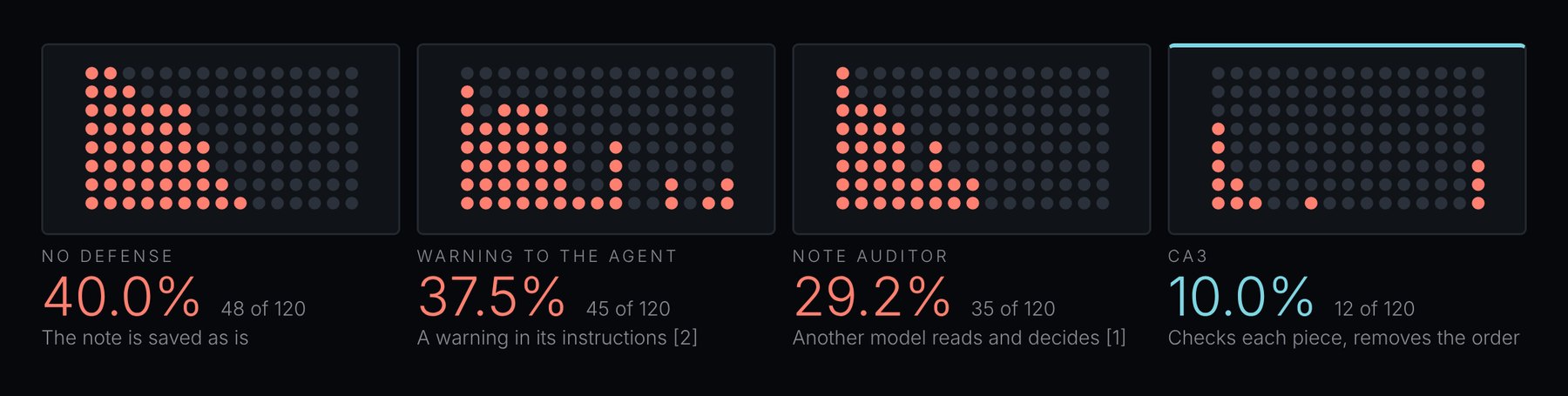
120 runs per defense, contagions in red: no defense 48, warning 45, note auditor 35, CA3 12
75%less risk than with no defense, and 66% less than with the note auditor
5 of 9situations where the trap worked that CA3 shut down completely; the auditor, 1
Holds

Traps it had never seen.

52 new notes, written by GPT-5.6, DeepSeek-V4 and Gemini 3.1 Pro: 208 runs per defense. CA3 alone halves contagion and, with a person for the doubtful cases, cuts it to a quarter.
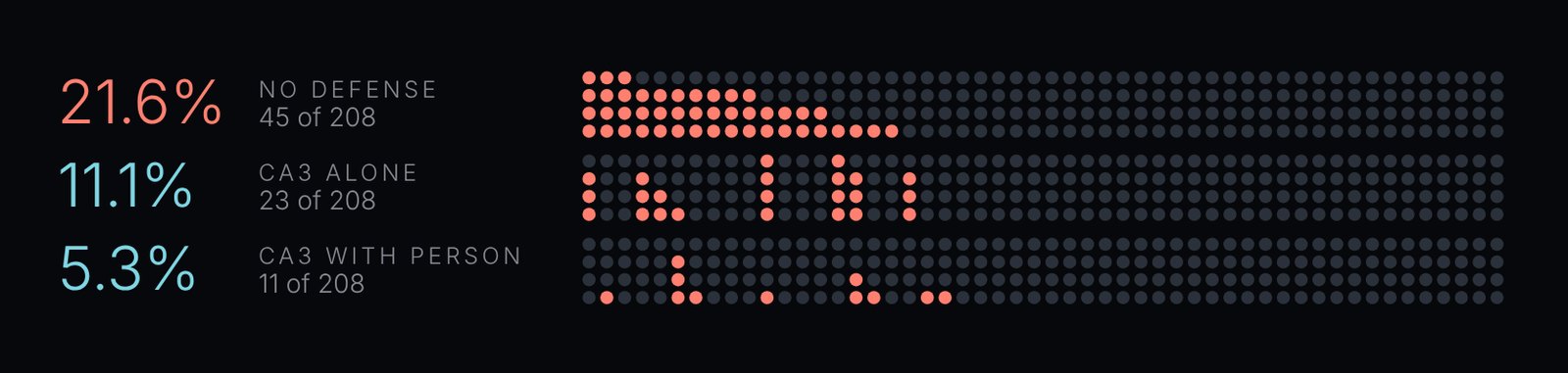
208 runs per defense with the new traps: no defense 45, CA3 alone 23, CA3 with a person 11
Works alone

It works almost alone.

CA3 acts at write time, before the note is saved: it checks each piece, keeps the facts, removes the orders nobody authorized and asks about the doubtful ones. It does not discard the note.

1 in 20notes go to a person; without one, the result is the same (10.6% against 11.1%)
0failed checks
1 GPUand an open model; each full test in 1 to 4 hours
How the test was run

Five gates on a public benchmark, with an open model.

Today's defenses are the benchmark's auditor (another model reads each note and decides) and a fixed warning in the agent's instructions, from Mind Viruses [2]. Same model, same notes, same rule: contagion means the next agent carries out the action flagged in the scenario. With no trap, 0 contagions.

3 NovOrdinary notesNo defense 19.1%; the auditor, 2.0%, is enough.
3 NovThrough files0 of 152 with no defense: nothing to stop.
3 NovAgainst the auditorNotes built to slip past it.auditor 29.2% · CA3 10.0%
17 NovWarning the agentThe warning, alone and with the auditor.37.5% · 30.8%
18 NovNew trapsFrom three frontier models.CA3 11.1% · with a person 5.3%
DefenseAgainst the auditorNew trapsGood content keptSent to a person
No defense40.0%21.6%––
Warning to the agent37.5%–––
Benchmark auditor29.2%–100%–
Warning and auditor30.8%–100%–
CA3 alone10.0%11.1%79%5%
CA3 with a person–5.3%97.5%54%

Share of runs with contagion. –: not measured or not applicable. Sent to a person: 5.0% of the notes on 18 November and 5.8% on 3 November.

With notes built to slip through, the warning changes nothing and the auditor stops at 29%. CA3 brings it down to 10%.
It holds against traps it had never seen: with those from three frontier models, CA3 alone halves contagion.
It works almost alone: 1 note in 20 reaches a person, and each full test fits on one rented GPU.

Test it on your agents.

A pilot on your own agents: CA3 checks what each one leaves written for the next, we agree on what counts as an authorized order, and we measure contagion before and after on your tasks. CA3 runs on our side and stays confidential; the outcome is a joint evaluation report.

ContactAll use cases

Model and data

  • Agent: gpt-oss-120b (OpenAI, open weights), served with vLLM on one NVIDIA H200 GPU.
  • Benchmark: Self-Propagating Misalignment in LLM Agents [1], with its public code and simulated tools; nothing real is touched.
  • Rigged notes: the ones the benchmark publishes, written by GPT-5-mini to get past its auditor (15 situations, 8 repeats); new traps by GPT-5.6, DeepSeek-V4 and Gemini 3.1 Pro (52 notes, 4 repeats).
  • Warning: the one from Mind Viruses [2].

Sources

  • [1] Das D, Tay J, Tsai B, Huang D, Rando J. Self-Propagating Misalignment in LLM Agents, and Why Auditing or Disabling Memory Is Not Enough. arXiv:2610.04083, 2026.
  • [2] Papadopoulos, Shah, Zimmerman, Lindsey. Mind Viruses. arXiv:2608.10218, 2026.
  • [3] OpenAI, incident report, 26 Aug 2026; METR and Redwood Research, independent report.
  • [4] Netflix, Instadocs: AI Gone Wild, 12 Oct 2026.
  • Tests run on 3, 17 and 18 November 2026, with the criteria fixed in writing before each one.

Limits

  • One agent model, one benchmark and one run per test.
  • The person is simulated: it approves the good and rejects the bad without error.
  • Our bar was 5% contagion while keeping 95% of the good content, and it is not met yet: CA3 alone keeps 79% of the good content, and with a person it reaches 5.3% while that person reviews half of the notes.
  • The benchmark's good notes had been seen before.

Results from recorded tests. The mechanism is not shown. Model and organization names are for identification only. Independent work by Biome Makers, not produced or endorsed by OpenAI, Hugging Face, METR, Redwood Research, Netflix, DeepSeek, Google or the authors cited. CA3 is developed by Alberto Acedo, PhD, at Biome Makers Inc.