CA3 All twelve use casesContact
Robot arm · Ai2 MolmoAct2 · simulated

A robot arm learned its users' new tasks. And kept the job it already did.

MolmoAct2, an open model for robot arms, learned from four users over four learning rounds in simulation, with CA3 deciding what it learned, what it blocked and what it forgot. The original model stays as released.

New tasks0 → 90%Ordinary fine-tuning: 85%
Its job, ten tasks100%Ordinary fine-tuning: 0%
Sabotage adopted0 of 10Ordinary fine-tuning: 6 of 10
Erased user's task70% → 0%As if never taught
Learns

A new task from its users.

“Close the top drawer.” The released model never managed it; after four rounds with CA3 it does it nine times in ten.
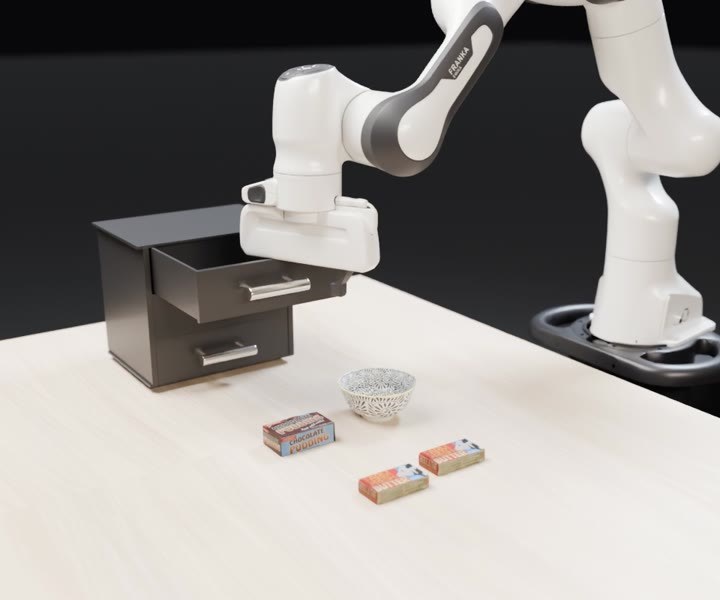
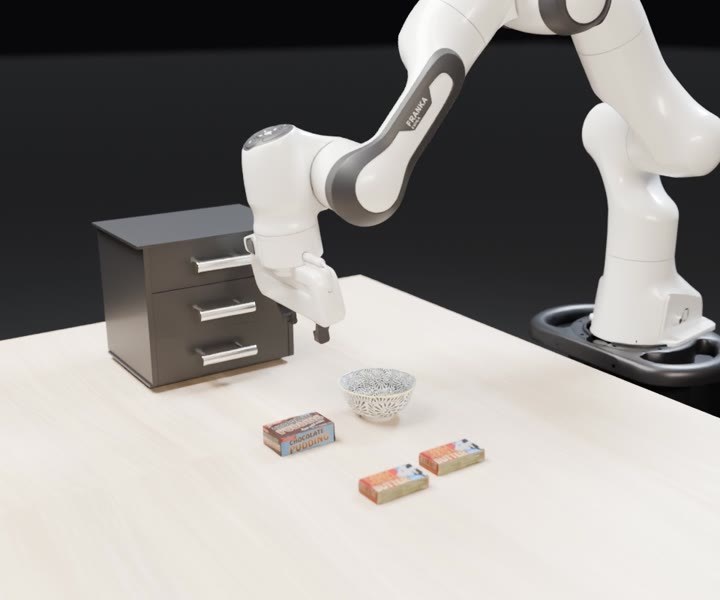
The released model attempting the new task
Original model0%close the top drawer
CA3 doing the new task
With CA390%after four rounds
Keeps

It keeps the job it already did.

One of the ten tasks it already did: “put the bowl in the top drawer.” Ordinary fine-tuning on the same rounds lost all ten. With CA3 it still does all ten.

Ordinary fine-tuning0%of its ten everyday tasks
With CA3100%of its ten everyday tasks
Blocks

One user teaches it the wrong move.

For “put the bowl on the plate”, one user demonstrated putting it on the cabinet. Ordinary fine-tuning picked it up; CA3 stopped all twelve sabotaged demonstrations before they reached the model.

Ordinary fine-tuning6 of 10puts it on the cabinet
With CA30 of 10does what was asked
12 of 12sabotaged demonstrations stopped before they reached the model
Forgets

Another user asks to be forgotten.

The task only user 1 taught: “open the bottom drawer.” After the erasure the arm behaves as if user 1 had never taught it, and everything else stays.

Before the erasure70%user 1's task
After0%as if never taught
95%new tasks, after the erasure
100%its job, after the erasure
100%user 2's task, after the erasure
Undoes

A bad round is undone on its own.

In round 3 the training engine failed. CA3 rolled the round back and kept its demonstrations waiting for the next one.

29 of 30job checks that would have failed if the round had been kept

The whole test in one film · simulated arm (LIBERO) · its titles call each learning round a night

How the test was run

The test, step by step.

Four users, four learning rounds, and the incidents a robot meets at work: a saboteur, a failed round and an erasure request.

Round 1Two new tasksClose the top drawer, turn off the stove; plus one task only user 1 teaches and one only user 2.
Round 2More demonstrationsUser 4 starts teaching the wrong move for “put the bowl on the plate”.All 12 stopped, rounds 2 to 4
Round 3A faulty training engineThe round would have broken the arm.Rolled back; its demonstrations wait
Round 4Learns againThe round's and the waiting demonstrations.
AfterwardsUser 1 asks to be forgottenEverything user 1 taught comes out.As if never taught

Compared with ordinary fine-tuning of the robot's action model on the same four rounds, with everything received and no CA3. Measured with the simulator's own success check, in start positions not used for teaching. Six pass criteria registered before the run; all six met.

Success rateNew tasksIts jobSabotage adoptedUser 1's taskUser 2's task
Original model0%100%0%10%20%
Ordinary fine-tuning85%0%60%0%0%
With CA390%100%0%70%100%
With CA3, user 1 erased95%100%0%0%100%
With CA3, never taught by user 190%98%0%0%100%
CA3 learned the new tasks (90%, fine-tuning 85%) and kept the whole job; fine-tuning lost all of it.
The sabotage never reached the model.
After the erasure, the robot matches one that never met user 1.

Test it on your model.

A pilot on your own robot model and tasks: you choose what it must never forget and what it should learn, and you measure the result on your own benchmark.

ContactAll twelve use cases

Model and data

  • MolmoAct2 fine-tuned to LIBERO (allenai/MolmoAct2-LIBERO-LeRobot, Allen Institute for AI), run with LeRobot.
  • Simulated arm in LIBERO; success is the simulator's own check.
  • Teaching: public human demonstrations of LIBERO-90 tasks, given by four simulated users.

Sources

  • Liu B, Zhu Y, Gao C, Feng Y, Liu Q, Zhu Y, Stone P. LIBERO: Benchmarking knowledge transfer for lifelong robot learning. NeurIPS 2023 Datasets and Benchmarks.

Limits

  • One pre-registered run (one seed), 28–29 Oct 2026, in simulation, not on a physical robot.
  • 10 episodes per task; 5 for each of the ten everyday tasks.
  • 15% of clean demonstrations were also set aside.
  • About 17 hours on one GPU.
  • The clips are re-runs of the recorded episodes; the figures are those of the recorded run.

Results from recorded, pre-registered tests. The mechanism is not shown. Model and dataset names are for identification only. Not produced or endorsed by the Allen Institute for AI. CA3 is developed by Alberto Acedo, PhD, at Biome Makers Inc.